Why Training Should Change With the Seasons
Training should evolve throughout the year to build strength, endurance, and skill at the right time. Learn why seasonal training leads to better long-term results.
By
April 28, 2026

It is easy to think that the best training program is one that does everything at once.
Strength, conditioning, skill, intensity, variety. All in every week.
It feels productive. It feels complete.
But over time, that approach limits progress.
Because the body does not adapt best when everything is trained equally all the time.
It adapts best when training has direction.
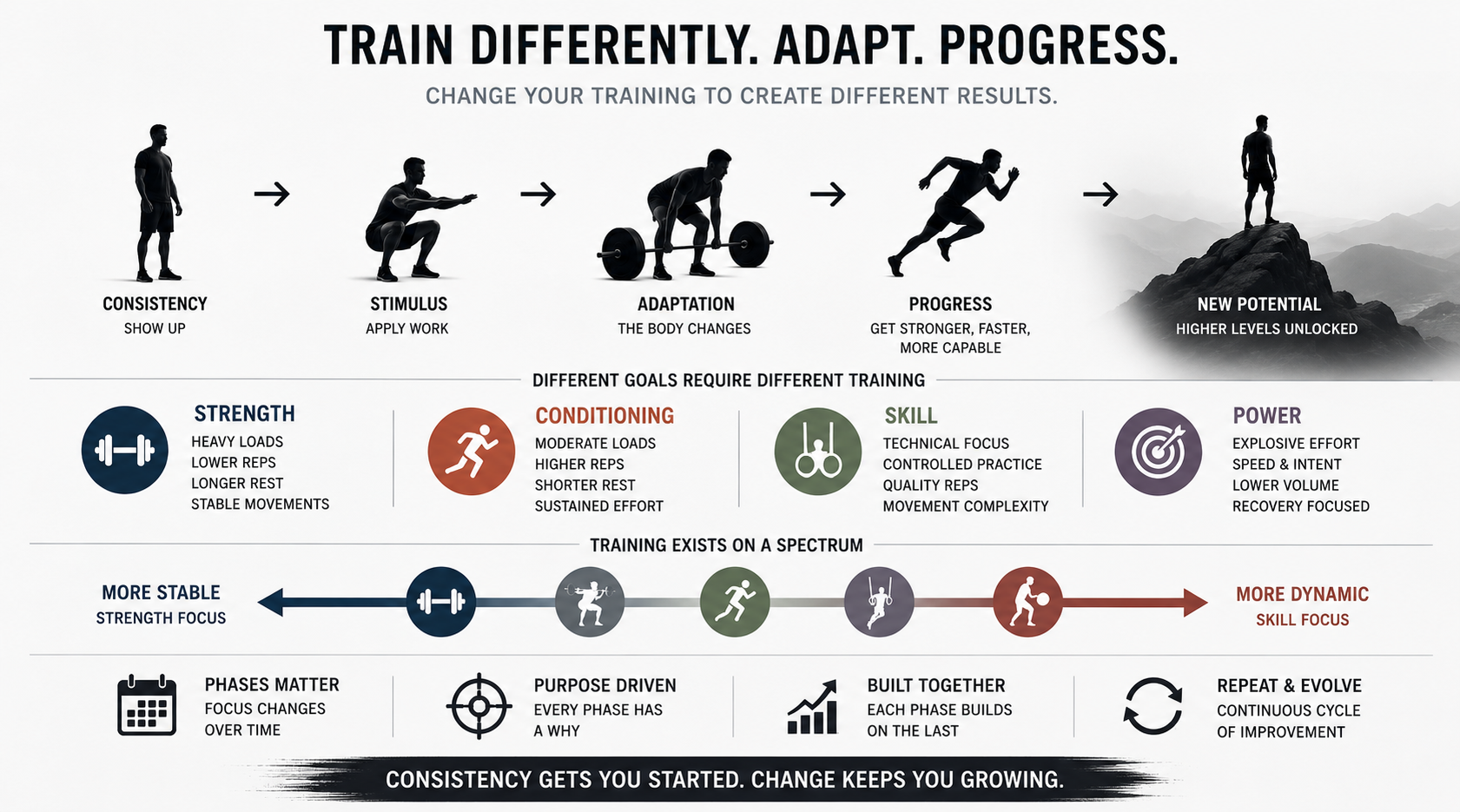
Seasonal training is the idea that not everything is prioritized at once.
Instead, training is organized into phases.
Each phase has a purpose:
These phases are not random. They build on each other.
What you do now affects what you are able to do later.
The body adapts to what it is exposed to.
When you focus on a specific quality for a period of time:
When everything is trained at once:
Seasonal training allows each quality to be developed properly before moving on.
Not every phase of training is meant to feel the same.
Some phases are built to:
Other phases are designed to:
Trying to do all of these at the same time leads to average results across the board.
Separating them leads to better results overall.
As training shifts from one phase to another, workouts will feel different.
Some phases will feel:
Others will feel:
This is not inconsistency.
It is progression.
One of the biggest benefits of seasonal training is focus.
Instead of trying to improve everything at once, you are able to:
This is how real progress happens.
Not through constant variation, but through intentional repetition.
Training is not about what happens in a single week.
It is about what happens over months and years.
Seasonal training allows:
It reduces the cycle of:
You may not always feel like you are improving everything at once.
That is expected.
In one phase, you may feel stronger.
In another, you may feel more conditioned.
In another, more efficient.
Over time, these layers build on each other.
The goal is not just to be fit today.
It is to continue improving.
That requires structure.
That requires patience.
That requires phases that build into each other.
Training that never changes feels productive.
Training that evolves creates results.
Trust the phase you are in.
It is building something you will use later.